Science & Public Voice

03
Science,
Translated
Into Stories.
Writing · Editing · Publishing

Ideas Worth
Understanding.

Writing gives me a space to follow questions beyond disciplinary boundaries—from globalization and philosophy to the social systems surrounding science and human life.

01 · Science Communication

No Limits

Making science rigorous,
readable, and worth sharing.
10+Student submissions edited and curated
700+Readers reached
1,000+Annual digital views
40+ yrsof No Limits at Hotchkiss

As Editor-in-Chief of No Limits, The Hotchkiss School's STEM magazine, I work with student writers to translate complex scientific ideas into clear and engaging stories. I oversee the publication process from topic development and editing to layout and final publication, while helping writers strengthen both scientific accuracy and narrative structure. Across topics including CRISPR, schizencephaly, biomedicine, and emerging medical research, I have learned that communicating science is not simply about simplifying information—it is about deciding what matters, what needs context, and what will make a reader want to keep asking questions.

I also contribute my own writing, including a feature on coronary artery bypass grafting (CABG) inspired by my growing interest in cardiovascular medicine.
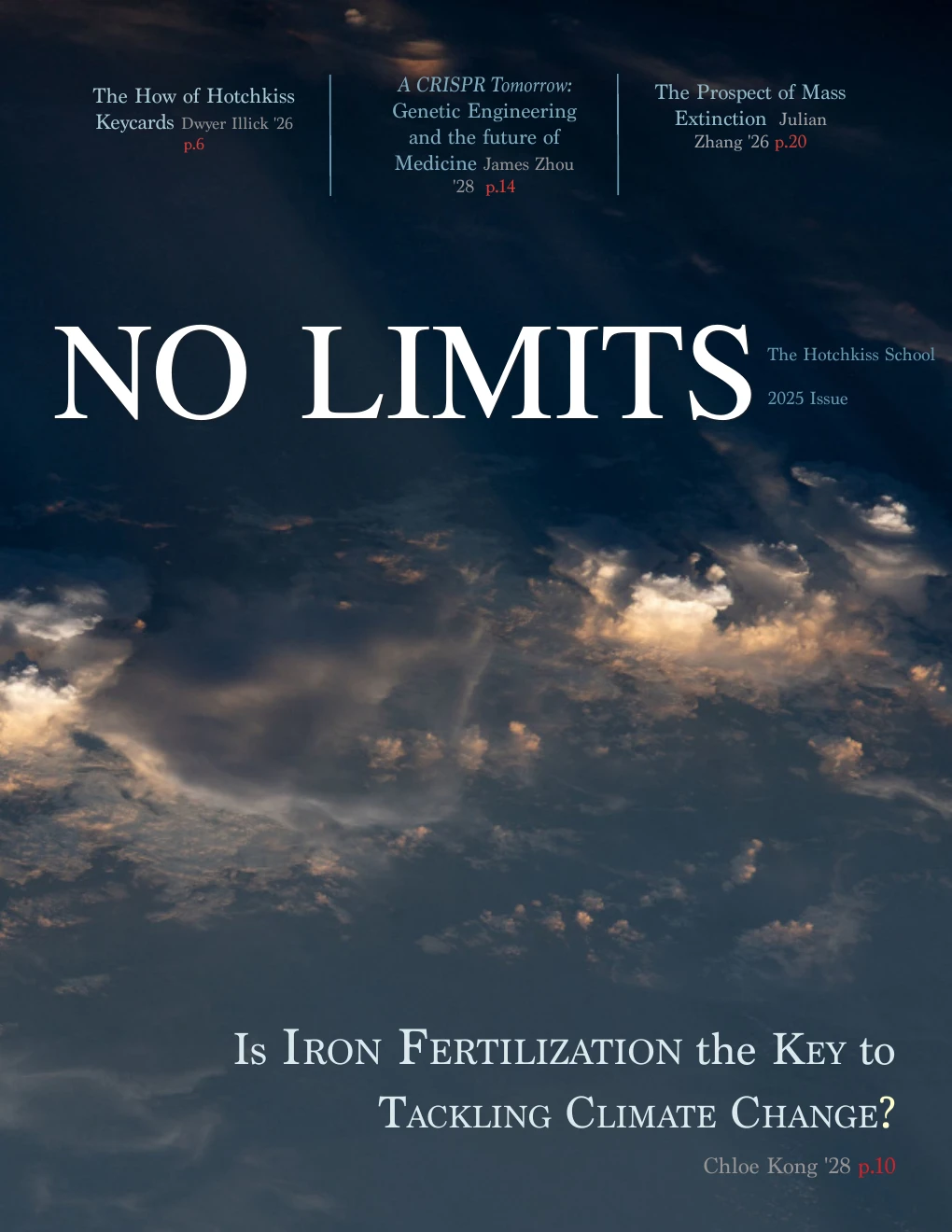
Cover of No Limits Spring 2025, The Hotchkiss School STEM magazine

No Limits · Spring 2025

46 Pages · PDF

Read Our Magazine

Globalization

Cambridge Re:Think Essay Competition

Bronze Award

Top 0.25%Worldwide

Published InThe Hotchkiss Economics and Financial Times Equilibrium

In a 2,000+ word essay, I examined globalization as a force that connects economies, cultures, politics, and technology while also producing inequality, exploitation, cultural homogenization, and environmental costs. Drawing on thinkers including Joseph Stiglitz, Thomas Piketty, and Amartya Sen, I moved beyond the question of whether globalization is simply beneficial or harmful, asking instead how global systems might be reformed to distribute their benefits more equitably.

Read More

Philosophy

John Locke Essay Competition

Shortlisted
Published InCurieux Academic Journal

Philosophical writing gave me a different way to approach complex questions—through argument, interpretation, and critical reasoning rather than empirical evidence alone. Through this paper, I learned to engage with competing perspectives, question assumptions, and build an argument that remains open to complexity rather than reducing a problem to a single answer.

Read More
Continue ExploringCreative